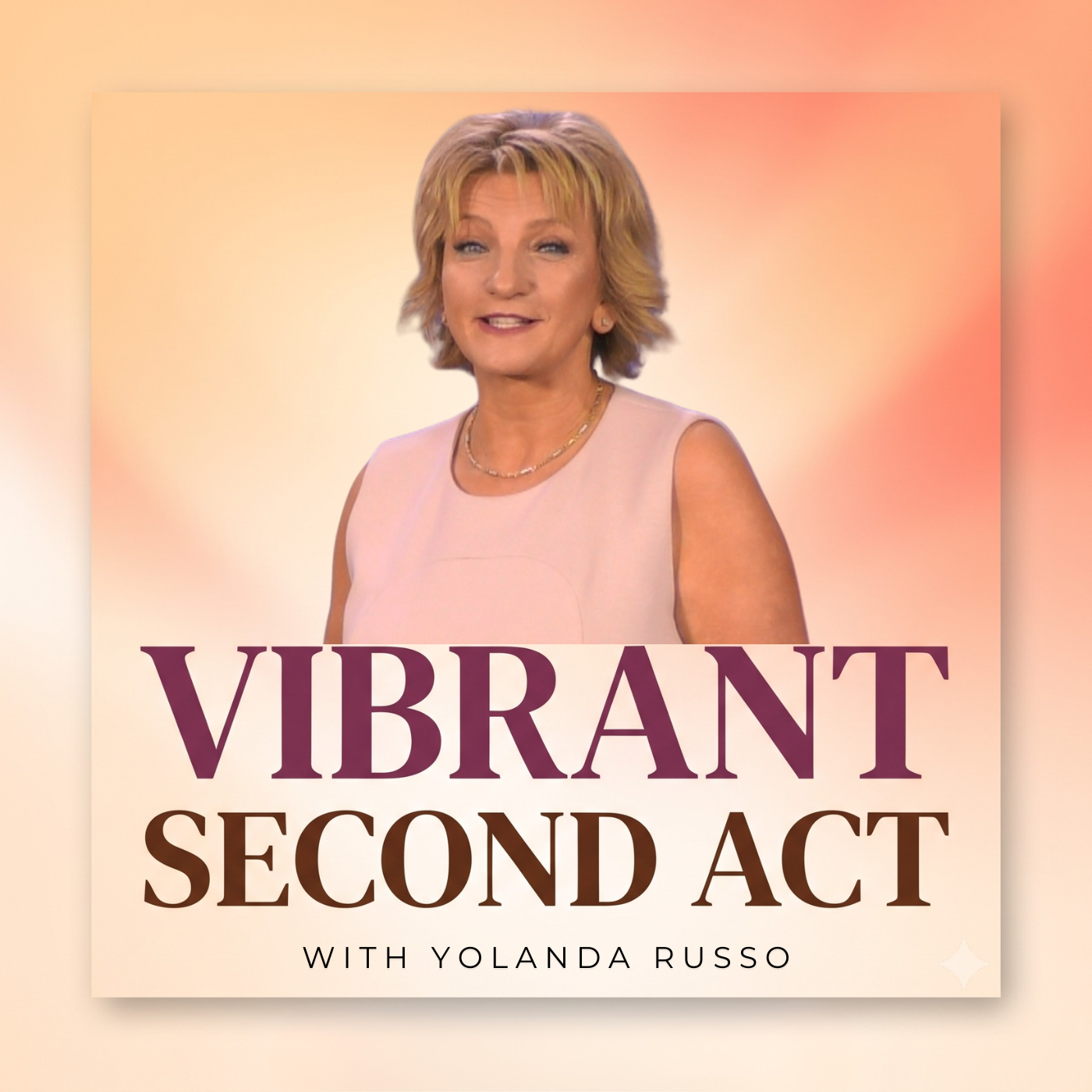
Episode 7
The Midlife Upgrade: Rebuild Muscle & Energy After 50 | Annie Gaudreault
We reject the idea that life after fifty is a slow decline.
Menopause is not the finish line—it is the beginning of a long, capable chapter.
In this episode of Vibrant Second Act, licensed nutritionist and women’s health coach Annie Gaudreault shares how she went from zero athletic background to running marathons right before turning fifty. She explains how stepping into physical pursuits and finding a strong female community shifted her mindset, dispelled feelings of invisibility, and proved that the female body remains remarkably adaptable.
We examine the science behind your next thirty years. The research confirms that natural menopause is followed by an average of 33 years—roughly 40% of your adult life. Genetics account for only 25% of that trajectory. The remaining 75% comes directly down to your daily choices: intentional movement, sleep protection, stress regulation, and eating food as cellular fuel.
When you replace fear with clear habits and biological agency, you step forward with strength, purpose, and vitality. You shape these years on your terms.
Connect with Annie Gaudreault
- Website: veev.ca (Book a complimentary midlife health strategy call)
- on Instagram @veev_wellness
Connect with Yolanda Russo
- Face Method™ Live Online Classes: beautyoncommand.com
- Media & Speaking: yolandarusso.com
- YouTube Channel: youtube.com/@beautyoncommand
Aging is inevitable — but how you age is in your hands.
Transcript
Welcome to Vibrant Second Act.
This podcast is dedicated to helping you build strength, confidence, and radiant vitality from the inside out.
Let's get into it.
We are often told that after 50, our energy naturally fades and feel uncomfortable about this.
I remember myself in just sitting on the couch watching tv, and all of a sudden I was feeling so comfortable and I remembered my grandfather and I said, no, no, no.
Get going.
The second act is not about winding down and slowing down.
It's about stepping forward with intention, clarity, and full awareness of our body is shifting.
Today's guest completely rejects that script.
Annie Godreau went on to concur.
Massive physical endurance.
She started running marathons.
Licensed nutritionist.
She's a licensed nutritionist, women's health coach, and founder of Vive Health and Wellness.
Welcome, Annie.
Speaker B:Thank you, Yolanda.
It's wonderful to be here.
Speaker A:I definitely want to know right from get go, what was the motivation behind you starting running the marathon at 50 or after 50?
How old were you?
Speaker B:It was actually a little bit before 50, and the reason being that I was very stressed at the time, and somebody that I knew said, you know, Annie, I think that you may like running.
It will be good for your stress management.
And I had never thought of that, but it ended up being a great suggestion.
Speaker A:That is amazing.
Were you an athlete at all prior to that?
Speaker B:No.
And this is what I tell people every time I speak to women, that I had zero background.
I even really thought of myself as not very sporty, as we like to say sometimes.
Right.
I didn't think I had any aptitudes towards, you know, sports and exercise.
So it's interesting how the stories that we tell ourselves will really influence how we live, but it ended up being a great journey.
Speaker A:That is so amazing.
Not everyone could take on marathon running to just feel better, but in your case, you actually were looking for community of women who are supporting each other.
Speaker B:Yes.
I would say that at the time, I was very lonely.
And I don't think that I realized how lonely I was.
All I had done for so many years is work, committed to my work and sacrificed so many things.
And when I joined a group for my first marathon, it was a women's marathoning group.
And that, Yolanda, proved to be a magic combination.
Speaker A:That's amazing.
That is completely amazing.
And, you know, many of us who are listening to this episode can align with this.
We are.
We are working a little too many hours, have responsibilities at home, and have to kind of take care of our parents at this time, too.
We're in the Sandwich generation.
So I agree we are spending ourselves a lot, but to choose that, that is admirable.
You definitely are showing us that menopause is not the finish line.
It's a start of the next chapter.
And.
And you're saying science proved that we can live another 33 years fully capable of doing everything as we were doing before?
Yeah.
Speaker B:I think that what's important for, you know, all the amazing women that are listening to your podcast, Yolanda, is that not to be.
Not to be fearing menopause, but to actually know that science is on their side.
Right.
The average, you know, number of years to live after a natural menopause, that is natural versus surgical, will be 33 years.
Right.
This is 40% of our adult life that we get to live after menopause.
So it's a wonderful time for discovery and what I like to call transformation.
We have the opportunity to decide how, what do these 33 years are going to be for us.
Speaker A:Yes.
And I love, when I was reading through your material, I love that you said we should be preparing for this stage of life, not just allowing to take its own course.
Speaker B:Absolutely.
Because we think often as of.
Of aging and these, These stages of life as a very genetic process, Right?
Oh, well, these are my genes, so this is how I'm going to age.
The fact is that 75% of how we are going to age are dictated by lifestyle factors.
Those are factors that we can influence, like movement, stress management, diet, et cetera.
Genetic is only 25%.
So we have a lot of agency to dictate how these next decades are going to be.
Speaker A:No, absolutely, yes.
I even discovered that some of the doctors, Dr. Bruce Lipton or others, they're even saying that it's less than 25%.
Speaker B:Yes.
Speaker A:So we have.
The power is in our hands and of course, in our willingness to go out and do things as normal as we could possibly do without fearing of the comments that come from society, from everyone around us, oh, you should slow down.
You should never do that marathon or such things.
So, yes, so we should be.
We should know that we are capable and we are fully equipped in the strength until the last day we're here on this planet, 100%.
Speaker B:Our bodies are a lot stronger, a lot more resilient.
You know, the reality is that there has been so much misinformation about aging, so much fear, as, you know, around what our quality of life can be.
Speaker A:Yes.
And I suspect that was intentional because nobody talks about men at 50, and usually when they do studies, they usually Study men for all those health components or the aging part, never women.
Maybe it's getting better lately, but that's exactly what I'm not liking because we were, we were put down.
We were, we were asked to fade into the background as we are aging.
And you certainly are proving this otherwise.
And now you're teaching that too.
Speaker B:Absolutely.
And you're right.
Women were excluded of research for the longest time.
We are still extremely behind.
It's very scary when you start to see the percentage of money allocated to women's conditions and never mind menopause and then postmenopause.
And it's interesting because a lot of people, you know, will criticize some of these studies on postmenopausal women and there's only like 75 or 100 women involved.
But the reality is that the funding is not there.
It's not always the researcher's fault.
So we have a long way to go.
But I am excited because we are finally starting to see some progress.
Speaker A:We are.
And I do hear that, that it's actually taking a different turn.
And the hormone therapy that was supposedly like death sentence, if someone was asking about that, now it's turning, it's shifting to, yes, that's a possibility.
And it is not something that is going to harm you.
You need to have a good doctor or quality care to support that.
But nobody's going to tell you, no, don't go that route.
Speaker B:Exactly, exactly.
Speaker A:So in addition to, to the hormones and to the body shifting into, into a different perspective, we are also.
Our mindset is absorbed.
Our mind is absorbing all the information from the outside.
And our mindset is made up to, to kind of allow and agree to and stand in the background of everything or everybody.
So mindset has a lot to do with this.
And what you have done when you went and joined the groups and just competed, that actually changed your mindset, didn't it?
Speaker B:Oh, very much.
I would say that it's probably one of the best things I've ever done in my life for myself.
One of the best decisions, 100%.
And we know from, we know from research and from these incredible thought leaders you were mentioning, Bruce Lipton before, that we absorb what is around us.
Speaker A:Right.
Speaker B:So when you surround yourself with the people who are doing these events, whether it is marathoning for somebody else, it might be something else.
Right.
When we surround ourselves with people who share these values of, of physical pursuit, endurance, I want to, you know, like, I know some women who are going for their PhDs and their 50s and 60s when you surround yourself with people who share your values.
When you constantly challenge yourself, it truly is transformational from head to toe.
And it definitely starts with mindset.
I belong here because this is what I hear in my practice all the time.
Yolanda.
Women that say, I feel that I am now invisible.
Speaker A:Yes, unfortunately, that's true.
But hopefully if we hear less of this type of messaging, we are going to change our mind about this because we are not to fade out.
We're supposed to go on another journey.
And that journey is just as productive as the one before.
Except that we don't have to take care of everyone else but ourselves.
Speaker B:Exactly, exactly.
There's a wonderful doctor in the U.S. her name is Dr. Luanne Brison Dean.
You may be familiar with with her.
I'm mentioning her because she wrote a book and the title of her book is, is the Upgrade.
And her point of view, having worked exclusively with menopausal women and healthy aging framework, is that while our bodies and our brains actually change through this big hormonal shift that is the menopause, we are actually better on the other side.
Right.
This upgrade.
And I love that mindset.
Right.
That we're not in, we're not losing, we are gaining.
Speaker A:We are gaining.
Yes.
Because we always put ourselves on a back burner until the menopause happens.
Right?
Yes.
Speaker B:Yes.
Speaker A:Beautiful.
So this is, this is what we wanted to share with you.
I know we feel bloated, we feel frustrated, sometimes we feel unheard.
No, our doctors are dismissing our complaints.
But know this, that there are people, health coaches like Annie and others who can just jumpstart your, your, your, your health so that you can go and seek professional help if needed.
So let's get practical.
So how would would a, a woman who is feeling bloated and tired by 2pm what would, what should she be doing in the morning or night before?
Speaker B:Well, it's interesting you talk about the night before.
I was just giving you a workshop on sleep today, earlier today.
First of all, you know, making our self care time a priority, as you said.
Right.
Other people's agenda became our agenda in the past.
Now it's time to put some solid boundaries and start with self care.
No amount of supplements are going to replace a good night's sleep.
So protecting our sleep, that helps us make better decisions.
It helps us with our digestion, with our blood sugar levels.
You know, good health is truly holistic.
So I always say you have to focus on your pillars of good health, your nutrition, so your diet, making sure that you are, you know, Eating balanced meals every day.
It is possible that there are some dysregulation around digestion.
So sometimes we need to take a look at that, but also make priority to movement.
The good news is you don't have to run a marathon to feel good.
But movement on a daily basis becomes non negotiable.
It's sometimes it's modifying as well.
Maybe it's adding some yoga, some restorative movement as well, which will really help the body.
But usually when somebody is, is feeling completely what I will call off right now, which is not a scientific term, but we know as women, it's like, no, I don't feel good.
When we dig deeper, we see that these pillars are not being taken care of.
So really looking at those first and.
Speaker A:Foremost, and hydration is probably one of those additional things that we need to somehow women stop drinking enough water because I guess we are not spending a lot of energy anymore.
We are just doing our own things at our leisure.
And then the water intake I notice in my clients is much lower than it used to be.
So dehydration can also get you tired.
Speaker B:Absolutely.
That is a key component of, you know, your nutrition.
If you're not getting your water, if you're not getting your nutrients, you will definitely, you know, something is going to be dysregulated.
You might also need some, you know, we might need to fine tune your diet because certain things are no longer working for you.
We know that the gut health changes at menopause so often.
We have to look at, you know, the state of the gut health in order to be able to restore good digestion.
And good digestion means better absorption of your vitamins, of your minerals.
So it's all like, it's like a little domino effect, right?
Speaker A:Yes.
And it changes.
When we were in our 20s, 40s even, our focus was on dieting to get our body shrink down a little bit.
And at this point we should be comfortable with our body and manage our diets so we don't put so many carbs in our diet that it overwhelms the body.
But what would be your advice for women after 50, what is their meal plan?
Starting from breakfast?
Speaker B:It's much more important to balance your meals at this stage because it's a lot less forgiving from a blood sugar management standpoint.
So making sure that you are getting plenty of protein, plenty of fiber at each meal, not being afraid of fats.
I love the fact that you talked about how the focus has been on shrinking ourselves and now the focus is on making us as strong as possible.
Very important.
So fiber, healthy fats, plenty of protein at each meal.
That starts to make a big difference in terms of gut health.
I also very much focus on the aspect of fermented foods, Yolanda.
This is one of the key things from a healthy gut standpoint.
So that becomes something that I say, regardless of what your preferences are, there will be something that, you know, we can include in your diet that will help you.
So those would be, you know, foundationals.
Speaker A:So what could you add to breakfast and what could you take away?
So imagine someone is eating toast and eggs or eggs and, I don't know, avocado.
How would you create them?
Meal plan for someone after 50?
Speaker B:Yeah.
Simple changes could be changed.
A bread to a sourdough bread.
So we get fermented foods right there.
Not two or three pieces, but one piece, adding, you know, going to two pieces of two eggs.
Pardon me.
Versus one egg so that we have a little bit more protein, adding, you know, a quarter avocado for some healthy fats and the fiber boost that avocado produces.
And maybe with a little side of berries.
Right.
Again, more nutrients, more fiber.
That would make a great balanced breakfast that makes you feel good all.
All morning long.
And for those who want to avoid bread altogether, you can easily do, you know, a great bowl of Greek yogurt.
You can add seeds to this, you can add berries.
It will provide you with some healthy fats.
Again, great protein and plenty of fiber, and it will be delicious.
Speaker A:Yes.
And then at lunchtime, we have chicken, fish, or other proteins.
Speaker B:That's right, yes.
Speaker A:So every meal should include enough proteins to satisfy our taste.
So we don't crave the sugars.
Speaker B:Exactly.
Yes.
And, you know, women were afraid of eating too much protein.
Right.
We thought it would make us big, and we thought too much protein was going to make us bulky.
Speaker A:Right.
Speaker B:So I have still a lot of clients who fear, you know, the.
The protein.
But this will be a game changer for women when they start to be consistent with that, because protein digests slower in the stomach, so you stay full longer, and it avoids these big cravings that you were talking about.
Speaker A:Yeah.
Let's talk about the value of proteins in our health.
It affects the brain.
It affects the clarity, the physical stamina and rebuilding of the muscles so we don't become skinny in the muscles and bigger in the belly.
So basically, we need to have the balance, right?
Speaker B:Yes, we see a very big difference because as most people have heard, we start losing muscle mass, but we start losing muscle Mass, like in our 40s.
It begins soon.
And we can now tie the quality of our muscles to kind of quotation mark organ of longevity.
The healthier the muscle mass is, the healthier we can predict your longevity.
So protein is a key component to the quality of the muscle.
Makes you feel full longer, makes it stabilizes blood sugar levels along with some fiber.
In the case of, you know, cold water fish, really important for brain health, particularly for women, this is essential as well because we are very much predisposed, you know, two times more than men to cognitive degeneration.
So this is really, really important to focus on, you know, at each meal and it will help us make better decisions because we'll have less cravings, less temptations.
I'm going to grab some cookies, I'm going to grab this, I'm going to grab that.
You know, those decisions that we know are really, really hurting our health in the long term.
Speaker A:Yes, it is true.
When I have a piece of a cube of Parmesan cheese, I am not looking for snacks because it kind of offsets the need for it.
So that's a good, that's a good tip.
Just have some proteins within reach if you need to snack.
Speaker B:Exactly, exactly.
And sometimes life is life.
We're not always in control of, you know, the, the meals that were offered.
So it's nice to have some go tos that will quickly satisfy us, provide the body with the energy that it needs without sending us into this big blood sugar highs and lows.
Speaker A:Yes, exactly.
So now let's talk about what to do to rebuild those muscles or to strengthen those muscles.
It is not the cardio that we were doing before menopause.
It is now the weight, the resistance exercises, the little weights or just walking.
Speaker B:Right, that's right.
That's right.
It becomes, you know, from someone who loves cardio, I have been very guilty of this myself.
We love so much cardio, but it is no longer serving us in the same way when we get to this stage.
So absolutely, we need to embrace strength training, both because of the muscle and also because of the bone health, which becomes very vulnerable during these years as it is so sensitive to the decline of estrogen.
So very important to make strength training a part of our lifestyle.
Two sessions per week is all we need, but they need to be there consistently week in, week out, because this is how we're going to make those 33 years that we talked about at the beginning of the podcast.
This is how we're making sure that we remain independent, that we are not frail that if something, if we hit our knee, if we fall a little bit, we're not going to break a leg or a hip or something like that, which is what we see a lot with the elderly people.
So we want to keep that muscle mass really strong.
And you know, a lot of women are afraid of bulking up.
And I want to say to these women that they don't have to be afraid.
You really don't need to be afraid.
If you do two strength sessions per week, what you're going to start seeing is you are going to feel your muscles being stronger and firmer, but you're not going to look like Arnold.
Like, you do not have to be afraid.
You would have to spend 50 hours a week in the studio to become big and bulky.
Instead, think of you as strong.
I often say strong is unstoppable.
Like this makes us resilient.
Speaker A:Yes.
The healthy body.
Basically you look healthier when you have some muscles on your legs, your arms.
Yes.
So that's definite.
And I was reading somewhere about the muscle building capacity.
It takes about two weeks to build the muscle, so be patient.
However, it takes about, maybe even less than two weeks to lose the muscles.
So if you do nothing for two weeks, you will in fact lose what you were working towards.
Speaker B:Yes, so true.
This is why rain.
When people have surgeries in the hospital, they make those people walk as fast as possible because they know that the worst thing that we can do to someone is that they do not move.
And of course, modern life, there's a lot of us not moving enough, too much sitting, etc.
So getting out there, embracing strength, work and you know, I have a lot of clients who will tell me, I don't want to go to a gym, I don't want to be with these men, I don't want to be in spandex and so on.
And there are a lot of options that are online that you can do at home.
You can buy yourself some weights and you can do all of this in the comfort of your own home before maybe you are ready to go to a gym.
So start, start at home.
Speaker A:It requires motivation definitely to be alone and doing it, but it's possible.
Yes.
So in your health coaching, what is your framework?
How do you take women from here to there?
Speaker B:Yes.
So very much science based.
We look at what I call the six pillars of healthy aging.
It's important that we look at health not just as you know.
I like to joke that being healthy is not about eating more kale, if you like more kale.
Good.
But being healthy is a holistic process that includes, you know, the body, it includes nutrition and includes your environment.
It includes stress management.
It includes also emotional health.
Right.
You talked about the.
All of the incredible burden that women have to take care of everybody.
So it is a holistic process.
I take them through a customized process and we work week by week to strengthen and create these habits.
And as we all know, it takes time to make these changes.
Speaker A:Yes, it does.
It does.
And do you do any motivational?
Because you have to sometimes just get there a little.
We are a little stubborn to do change our habits.
So how do you overcome that?
Speaker B:I often have to.
This is such a good question, Yolanda.
I love this.
I often have to remind my clients why they are doing this work.
Right.
Because, you know, like, I'm in Canada, the weather is going to be cold soon, and then a lot of people will.
And you know, my clients are all over the world, but a lot of them will say, like, but Annie, it's cold and it's not motivating.
And I have to remind them of why it is that they're doing this.
You know, they want to age with independence.
They want to be able to pick up their grandkids from the floor.
Right.
They want to be able to travel.
They are afraid of disease.
Right.
They are afraid of.
My mother had diabetes and died from consequences of diabetes.
Right.
So there are a lot of things that you need to remind people sometimes because we forget.
We forget the deeper reasons for why we started this in the first place.
So I am the voice of reason.
Speaker A:The voice of reason.
Just last week, I have no idea where did I hear this, but it was so amazing.
This whoever the teacher was talking to the audience and said, when you go to the gym, you.
You one day, you're one day away from a nursing home.
Speaker B:Oh, wow.
Speaker A:That was pretty powerful.
Speaker B:Yes.
Speaker A:So.
So every time you go to the gym, think of, yes, I'm in it because I don't want to be dependent on the system or others.
So that's a good.
Speaker B:Very much so.
Speaker A:Yeah.
Yeah, perfect.
Annie, I know if, if our listeners want to find you, I know you have this beaut.
A business that you have developed.
Viv, can you tell us more about it and what they can do on your website?
Can you give us your website?
Speaker B:Yes.
So lots of information on my website.
Vee ca so V E E V dot ca there's lots of information there.
There's lots of information on various topics.
On each page you will find a contact me or talk to Annie button and you can book a complimentary call with me where we can talk about, you know, your concerns and then I can give you some strategies right there and then so that you know, you know the next step for your health.
That's also where we can talk about the programs that I offer.
But I have a, I have a virtual practice.
So it doesn't matter where you are located.
I have clients all over the place.
And it is customized one on one because there is no one size fits all solution here.
It needs to be customized.
Speaker A:Perfect.
That is what holistic means.
Exactly.
And I believe that age doesn't matter either.
Right.
It doesn't matter how old your customer is.
Could be 50, 60, 70.
And you can help them as well.
Speaker B:Absolutely.
I have many clients who are actually in their 70s who will say, I, I cannot believe it any, but I now because of you, you know, I have muscles.
I can see my biceps, my blood sugar levels are down, my blood pressure has improved.
It doesn't matter.
We know that from science that it doesn't matter.
When we start, the body will respond.
Speaker A:Yes.
As long as you are alive, your muscles are alive.
You just have to feed them.
Speaker B:Exactly.
Speaker A:Beautiful.
So thank you so much for joining us today on Vibrant Second act.
We all wish to be independent, capable, and just be able to enjoy the second part of our life into doing something that we always wanted but never had enough time for.
Speaker B:Let's do it, ladies.
We are strong and powerful.
Thank you so much, Yolanda.
Such a pleasure speaking with you today.
Speaker A:Oh, thank you so much.
And we will check out your website and see what we can learn from it right now.
Thank you so much.
Speaker B:Thank you.